Miner Tycoon : Big Dynamite
- 3.9
- Rating
- 1.00M
- Installs
- Free
- Price

 Analysis by App-foxy
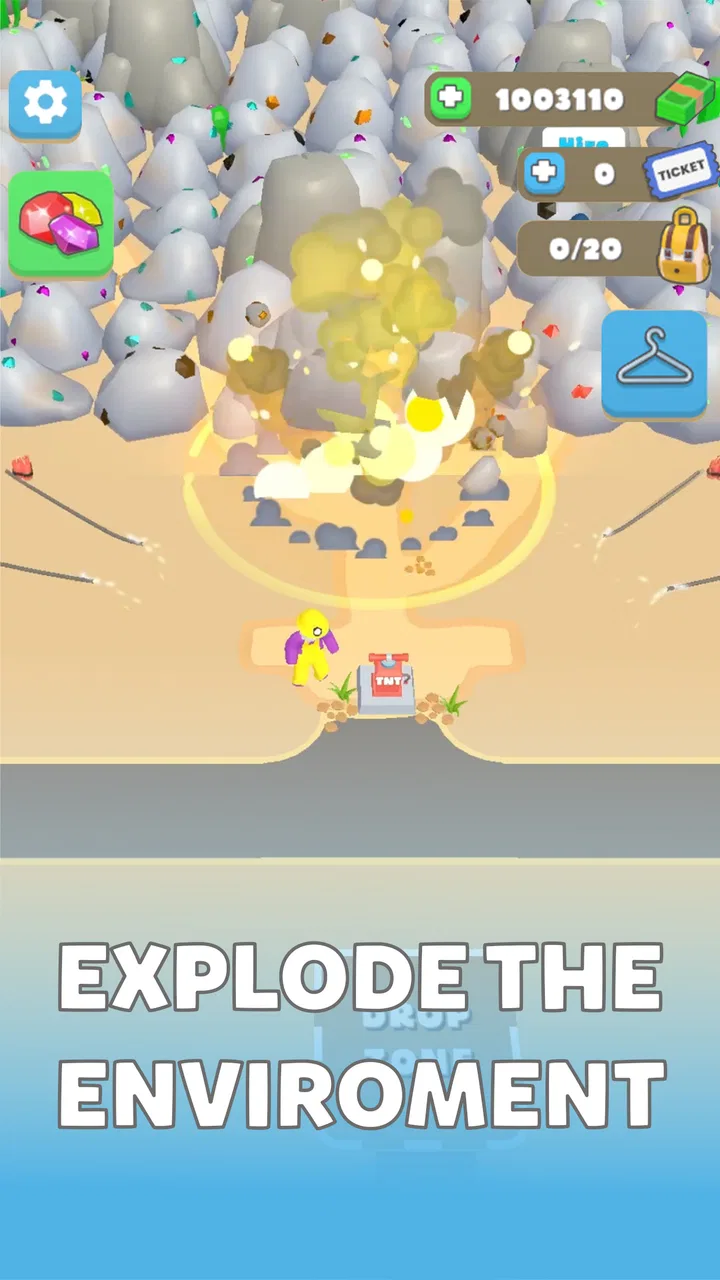
Mining games usually ask me to do one thing repeatedly: tap, dig, upgrade, and watch a number rise. Miner Tycoon: Big Dynamite takes a louder route. Its central appeal is the fantasy of blasting through valuable ground, gathering what comes out, selling it, and using the proceeds to push the operation further. That simple loop gives it an easy starting point, but the real question is whether the management layer adds enough thought to keep the explosions interesting.
I approached it as a short-session arcade game rather than a serious business simulator. That distinction matters. The game is published by BREW GAMES, belongs to the arcade category, and is free to install. It is aimed at Teen players, runs on devices using OS 10 or later, and its listed version is 2.0.3. Those details make it fairly approachable for people who want a casual mining-themed game without paying before trying it.
The store summary presents the idea in a few energetic verbs: detonate, collect, sell, and become wealthy. My experience is that the appeal comes from connecting those actions into a satisfying routine. You are not simply watching an idle counter; you are encouraged to think about the next step in the chain. The game works best when I treat each session as a small production cycle: create value underground, turn it into currency, then decide how aggressively to continue.
You May Also Like

 Blood Strike: 2.5 Anniversary
Blood Strike’s Loadouts Turn Every Drop Into a Tactical Gamble
A close look at Blood Strike’s custom loadouts: how fast access to signature weapons reshapes its battle royale rhythm, rewards preparation, and narrows the gap between fights.

 Pandora - Music & Podcasts
Pandora’s Music Is Easy to Start, but Harder to Recover
Pandora’s strength is its low-effort path from a seed to a station. Its weak spot is how much confidence it asks you to place in connection, setup, and quiet recovery.

 8 Ball Pool
 Is Built on Rivalries, Rematches, and Routine
A close look at the rivalries, rematches, shared routines, and unanswered safety questions that turn a quick pool match into a persistent mobile community.

 Samsung Music
’s Quiet Strength Is Playing What You Already Own
Its reach comes less from spectacle than from dependable access to a personal library. That simplicity is both the app’s strongest retention engine and its ceiling.

 AccuWeather: Weather Radar
AccuWeather Review: A Quick, Clear Forecast for Everyday Decisions
For everyday plans, the best forecast is the one you can understand quickly. AccuWeather makes rain timing, radar, and local conditions easy to act on, with a few trade-offs.

 Hill Climb Racing
Why Hill Climb Racing Still Turns Crashes Into One More Run
A tiny car, a bumpy hill and one more upgrade: Hill Climb Racing keeps resurfacing because its simple chaos makes every near-miss feel personal.
More From Our News Desk



How the mining loop feels in everyday play
The first strength is clarity. Big Dynamite does not require a long explanation to communicate its purpose. Explosions create movement, collected materials represent progress, and selling gives the activity a visible reward. That makes it suitable for a quick break, especially when I want something more interactive than a completely passive idle game.
A realistic use case is a short commute or a few minutes between tasks. I can open the game, perform a handful of mining actions, convert the results into money, and stop without needing to remember a complicated story or a large set of objectives. The same structure also suits players who enjoy checking incremental progress several times during the day rather than committing to a long uninterrupted session.
What I like is the way the mining fantasy is tied to the economy. The blast is the exciting moment, but the sale is what gives it purpose. If I focus only on detonation, the game becomes a sequence of effects. When I pay attention to the collect-and-sell rhythm, each action feels connected to the next improvement. That small sense of ownership is where the “tycoon” idea earns its place.
At the same time, this is still an arcade experience. I would not approach it expecting the detailed logistics of a full management simulator. The title suggests a big industrial operation, but the accessible design is more about quick decisions and repeated rewards than designing a mine from the ground up. Players who enjoy spreadsheets, elaborate production chains, or deep economic modeling may find the management side lighter than expected.
Why the collect-and-sell step matters
A useful way to play is to avoid treating every reward as an immediate excuse to continue blasting. I found the selling stage more important than it first appears because it marks the point where activity becomes usable progress. In practice, I like to finish a small run before deciding what to do next instead of interrupting the rhythm after every individual find.
That approach also makes the game easier to evaluate. If a session produces a meaningful improvement, the loop feels efficient. If I spend too long repeating actions without a noticeable change in what I can do, the arcade simplicity starts to feel more like routine. The best sessions are therefore the ones where I set a modest goal, complete a mining cycle, and stop after reaching it.
This is one of the less obvious strengths of the design: the game can be enjoyed as a sequence of compact objectives even when the overall premise is about becoming extremely wealthy. I do not need to chase the biggest possible result every time. A small, completed cycle often feels better than an unfocused attempt to maximize everything at once.
What to expect from the pace
The pace is built around repetition, so patience matters. The first few rounds are easy to understand because the actions are direct. Later, the attraction depends on whether the player enjoys repeating a familiar process while gradually improving its outcome. That is common in the arcade and tycoon space, but it is still the main dividing line between players who will keep returning and players who will lose interest quickly.
I would recommend playing with a session limit in mind. For example, I might decide to complete one selling cycle before putting the phone away. This prevents the game from turning into an endless hunt for the next reward and makes its progress feel more intentional. It is also a practical way to judge whether the loop is genuinely enjoyable or merely easy to continue.
Another useful habit is to notice whether I am making a decision or simply repeating the last action automatically. When the game encourages me to choose when to collect, sell, or reinvest, it feels like a tycoon game. When I am only pressing through the same sequence, it feels closer to a conventional idle arcade title. That difference will matter more to experienced players than the mining theme itself.
Value, free access, and the real trade-offs
The cost structure is straightforward at the starting point: the game is free. That means I can test the core loop without committing money, which is a meaningful advantage for an arcade title whose long-term appeal depends heavily on personal tolerance for repetition. The listed in-app purchases range from $1.99 to $199.99 per item, so the free entry should not be confused with a completely purchase-free experience.
For me, the sensible value test is to play without buying first. If the basic mining, collecting, and selling cycle already feels rewarding, the free version has done its job. If the loop feels thin before any purchase, spending money is unlikely to solve the underlying issue. I prefer to make that judgment based on enjoyment rather than on the promise of reaching the largest possible fortune faster.
The broad purchase range is the main reason I would advise restraint. A low-cost optional item and a very high-priced item can exist in the same economy, but they do not represent the same kind of value. I would only consider a purchase after understanding exactly what it changes in my own play, whether that means saving time, reducing repetition, or supporting a game I already enjoy. I would not buy simply because the next upgrade feels slow.
This is also where the title differs from a paid arcade game. A one-time purchase usually lets me evaluate the full price against a fixed package. Here, the initial cost is zero, but the long-term spending decision is more personal and potentially open-ended. Players who prefer a clear, single payment may feel more comfortable with a premium alternative, even if that alternative lacks the mining theme.
There is a genuine trade-off between convenience and satisfaction. Faster progress can make the operation feel more powerful, but it can also remove the small decisions that make the loop worthwhile. I would rather keep the early progression intact long enough to understand what the game is asking me to manage. In a tycoon game, skipping too much of the climb can weaken the very fantasy the game is selling.
Where the game earns its value
The strongest value comes from accessibility. The game is free to start, the basic premise is immediately readable, and its arcade structure fits short sessions. That combination makes it a reasonable choice for someone who wants a mining-themed time filler without learning a complex system first.
It also has value for players who enjoy visible conversion: an action produces materials, materials become money, and money represents improved capacity. That chain is familiar, but the explosive presentation gives it a more active personality than a purely numerical idle game. I find that difference useful when I want the comfort of incremental progress without a completely passive experience.
Its value is weaker for anyone seeking a deep simulation. The game’s appeal is not likely to come from detailed planning alone. If I need intricate resource balancing, a large strategic map, or a long-form campaign, I would look elsewhere. The free price makes trying it easy, but it does not change the fact that the underlying loop is intentionally focused.
Small decisions that improve the experience
My first practical tip is to separate “fun actions” from “progress actions.” Detonating is the obvious fun moment, while selling is what confirms whether the session moved forward. Keeping those roles in mind helps me avoid spending too much time on blasts that do not lead to a satisfying result.
Second, I would treat the economy as a reason to pause, not just a reason to accelerate. When I reach a selling point, I take a moment to consider whether continuing immediately is actually enjoyable. This turns the game into a series of deliberate runs and makes the tycoon theme feel more present than simply chasing the next visual effect.
Third, I would not judge the game by its biggest possible purchase. Judge it by the free loop and by the lowest spending decision you would personally be comfortable making. That is a better measure of value because the game is available without an upfront fee, while the listed purchase range can extend much higher than a casual player may expect.
These habits are especially useful for younger players or anyone sharing a device. The Teen content rating is a reminder to approach the game as entertainment with a purchase system, not as a harmless toy with no financial considerations. I would keep spending decisions intentional and separate from the excitement of a particularly successful mining run.
Who should play it, and who should skip it
I think this game is a good fit for players who like arcade progression with a light management flavor. If you enjoy turning a simple action into a growing stream of rewards, the mining theme gives the familiar formula enough character to stand out. It is also a natural choice for people who prefer short sessions and want to return to the same project repeatedly rather than complete a fixed level and move on.
It suits casual players particularly well because the goal is easy to understand. You do not need prior knowledge of mining, economics, or tycoon games to begin. The free installation also lowers the risk of trying it, and the minimum OS requirement of 10 keeps it relevant to a reasonably modern mobile setup.
I would be more cautious if you dislike repeated actions. The game’s identity depends on doing similar things many times, so a player who needs constant new mechanics may find the loop predictable. Likewise, if you are looking for a competitive arcade game based on reflexes, this is not the same kind of challenge as a score-attack title. Its tension comes from managing progress, not from mastering rapid controls.
It may also be the wrong choice for someone who wants a completely fixed cost. The free entry is attractive, but the presence of in-app purchases means I would not recommend it to a player who strongly prefers games with no optional spending layer. A paid alternative with a single known price may provide a cleaner experience, even if it offers less immediate accessibility.
Compared with a standard idle miner, this game has a more active presentation because the detonation step gives the player something to do. Compared with a deeper tycoon simulator, it is easier to pick up but less suited to long planning sessions. Compared with a traditional arcade game, it offers more accumulation and less emphasis on reflex precision. That middle position is its clearest identity.
How the audience size affects my confidence
The game has passed one million installs and holds an average rating of 3.9 from around sixteen thousand ratings, alongside 455 written reviews. I read that combination as evidence of a recognizable audience rather than a guarantee that every player will enjoy it. The rating suggests a mixed but broadly workable experience: enough people find the loop appealing, while others likely run into the repetition or monetization trade-offs.
I would use those figures as context, not as a substitute for trying the game. A mining arcade game can be satisfying to one person and monotonous to another within the same short session. The free starting point is therefore more important than the popularity signal when deciding whether it deserves space on my phone.
My verdict on downloading and spending
My recommendation is to download it if you want a free, accessible arcade game built around explosive mining and incremental wealth. The basic premise is clear, the collect-and-sell rhythm gives the actions a purpose, and short sessions work naturally. I especially like it as a casual time filler when I want more involvement than an idle counter but less commitment than a full strategy game.
I would skip it if your priority is deep simulation, constant mechanical variety, or a clearly fixed one-time price. The repeated loop is not a flaw by accident; it is the foundation of the experience. If that foundation does not appeal to you during the free trial, purchases are not a good reason to stay.
As for spending, I would begin at zero and keep it that way until the game has proved that its ordinary loop is worth extending. The listed purchase range of $1.99 to $199.99 per item makes careful judgment important. For my taste, the best value is found in the free access and the ability to decide later, not in rushing toward the largest possible operation.
After trying it, I see Miner Tycoon: Big Dynamite as a focused arcade tycoon rather than a full mining simulation. Its strongest quality is the clean connection between blasting, collecting, selling, and gradual progress. Its main weakness is that the same clarity can become repetition. If you enjoy that rhythm, BREW GAMES’ game is easy to recommend as a free experiment. If you need richer strategy or a purchase model with no open-ended layer, your money and time are better directed elsewhere.
FAQs for Miner Tycoon : Big Dynamite
01What is Miner Tycoon: Big Dynamite about?
Miner Tycoon: Big Dynamite is an idle mining and management game in which you build and expand a mining operation. You collect valuable resources, upgrade equipment, hire or improve workers, and automate production so your business can continue earning while you are away. Progress comes from balancing investment, unlocking new areas, and using dynamite or other boosts strategically.
02Can I play Miner Tycoon: Big Dynamite without an internet connection?
The game may allow some progress while offline, particularly through idle earnings, but certain features can depend on an internet connection. Advertising rewards, cloud synchronization, updates, in-app purchases, and online events may require access to the network. If you plan to play during travel, it is best to test the game offline first and avoid assuming that every feature will remain available.
03Is Miner Tycoon: Big Dynamite free to download and play?
Miner Tycoon: Big Dynamite is generally available as a free download, allowing players to start mining without paying upfront. However, free-to-play systems can include optional in-app purchases, rewarded advertisements, and time-saving boosts. You can usually progress without spending money, although purchases may accelerate upgrades or reduce waiting. Parents should review device payment settings before allowing children to play.
04Does Miner Tycoon: Big Dynamite contain advertisements or in-app purchases?
Players should expect the possibility of advertisements and optional purchases, as these are common in idle tycoon games. Ads may be offered in exchange for extra resources, faster production, or temporary bonuses, while purchases can provide currency or progression boosts. The game can still be enjoyable for free, but frequent promotional prompts may affect the experience depending on how actively you use them.
05What devices are compatible with Miner Tycoon: Big Dynamite?
Compatibility depends on the version available through the Google Play Store or Apple App Store, including the operating system requirements and supported device architecture. Before downloading, check the official store listing for the latest Android or iOS version requirement, storage space, and developer information. Older phones may install the game but could experience slower performance, longer loading times, or reduced battery life.
Pros
- Simple controls make mining easy to learn.
- Short sessions work well for casual play.
- Frequent upgrades create a satisfying sense of progress.
- Offline play is convenient when you have no connection.
- Colorful visuals and effects make digging enjoyable.
Cons
- Progress can feel repetitive after extended play.
- Upgrade costs may become difficult to afford later.
- Advertising can interrupt the gameplay experience.
- Limited strategic depth may disappoint experienced players.
- Some features may depend on in-app purchases.

Miner Tycoon : Big Dynamite
Gallery